

Quick answer: An HWID spoofer changes the hardware identifiers a game reads from your computer. It is made for hardware bans and use with a new account, while the old banned account stays banned.
An HWID spoofer is software that changes the identifying values a game reads from your PC, including serial numbers associated with its components. After a hardware ban, its purpose is to let you play again from the same computer on a new account without replacing that computer.
What is an HWID spoofer?
An HWID spoofer changes the hardware identity your PC presents to a game.
HWID stands for hardware ID. Spoofing means changing the reported identifiers, so the game reads different values for the computer.
Your account is the login you use. Your hardware identity concerns the machine behind that login. A restriction can therefore follow the computer even when you use another account. That is why players start hearing about spoofers after a hardware ban: creating another login may leave the computer restriction in place.
What is a hardware ID?
A hardware ID is an identifying value, such as a component's serial number, that a game can read from your PC.
Think of the serial numbers associated with your motherboard, storage drive, display or memory. In conversations about bans, players often use HWID as a collective name for these identifiers. It does not necessarily mean one universal PC serial number.
A spoofer menu can also include a MAC address and a Volume ID. These labels refer to different things: the MAC address belongs to a network adapter, while the Volume ID identifies a storage volume.
Why do games ban hardware?
Games use hardware bans to restrict access from a computer beyond the restriction on an individual account.
In Riot's support article on hardware ID bans, the ban applies to the computer's physical components. Riot says game access is restricted and any login attempt results in the VAN 152 error. The computer remains relevant to the restriction when the login changes.
PUBG's anti-cheat update describes improvements to its hardware ban system alongside deployment of its Zakynthos anti-cheat system. The developers reported approximately 28% more hardware bans compared with the first half of 2022.
What does an HWID spoofer change?
The PUBG spoofer menu covers seven types of identifier, including component serial numbers, a MAC address and a Volume ID.
Each menu entry points to a particular part or identifying value. This is how to read the labels:
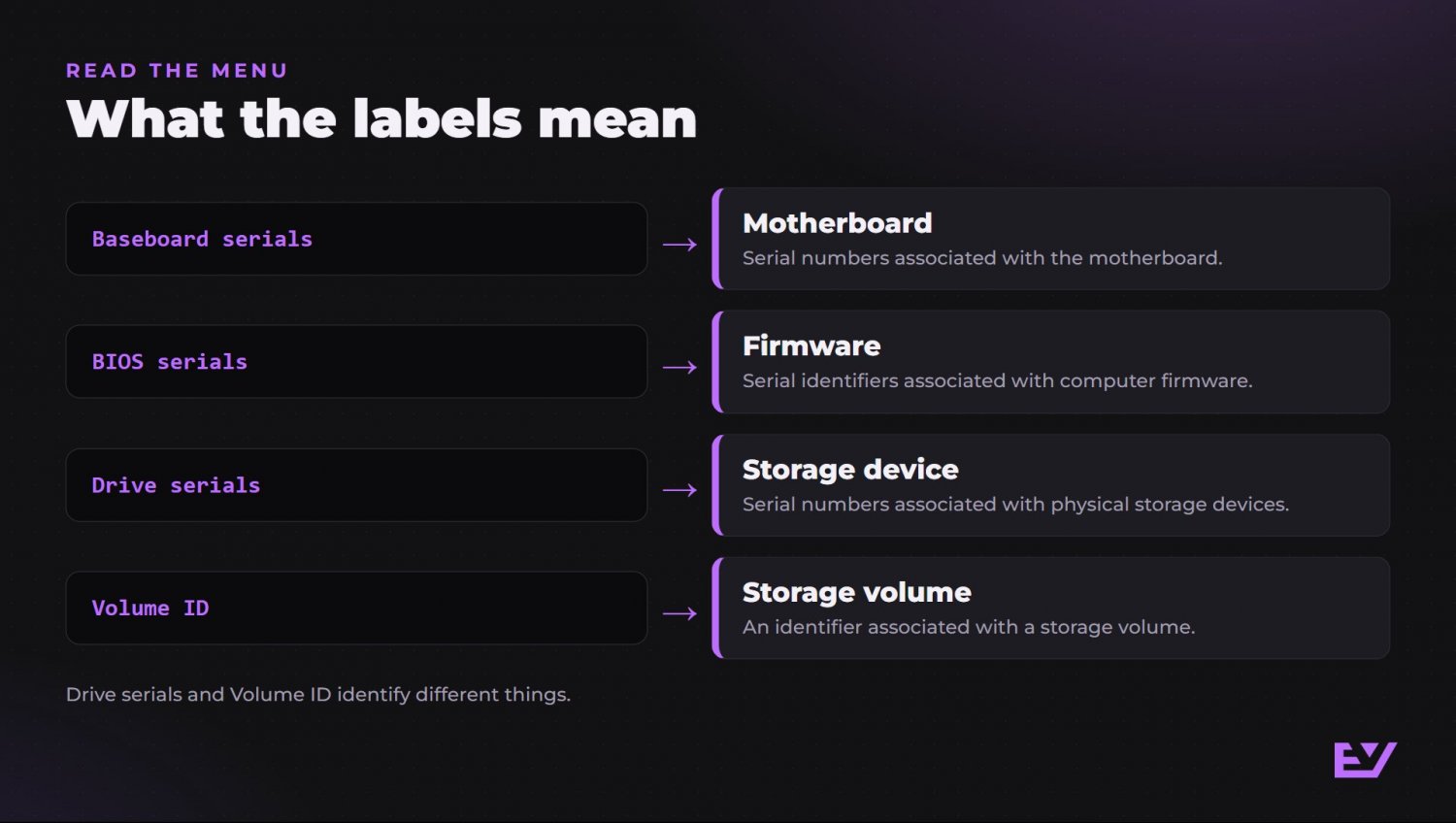
- Baseboard serials: serial numbers associated with your motherboard.
- BIOS serials: serial identifiers associated with the computer's firmware.
- Drive serials: serial numbers associated with physical storage devices.
- MAC address: the hardware address associated with a network adapter.
- Monitor serials: serial numbers associated with your display.
- Physical Memory serials: serial numbers associated with RAM modules.
- Volume ID: an identifier for a storage volume, distinct from a physical drive's serial number.
What is a spoofer used for?
A spoofer is made for playing again from the same PC on a new account after a hardware ban.
The Evicted HWID spoofer is made to help you bypass a hardware ban on a new account: it changes the hardware IDs the game reads, so you can play again from the same PC. Your old banned account stays banned.
Not sure whether the ban hit your account or your PC? The guide to checking an HWID ban shows how to tell.
Can a spoofer get you banned?
Yes: cheating breaks the game's rules and can lead to a ban; Epic's help article on the Hardware Identifiers Warning says detecting a tool that hides or changes hardware IDs may result in a permanent Fortnite account ban.
How much does an HWID spoofer cost?
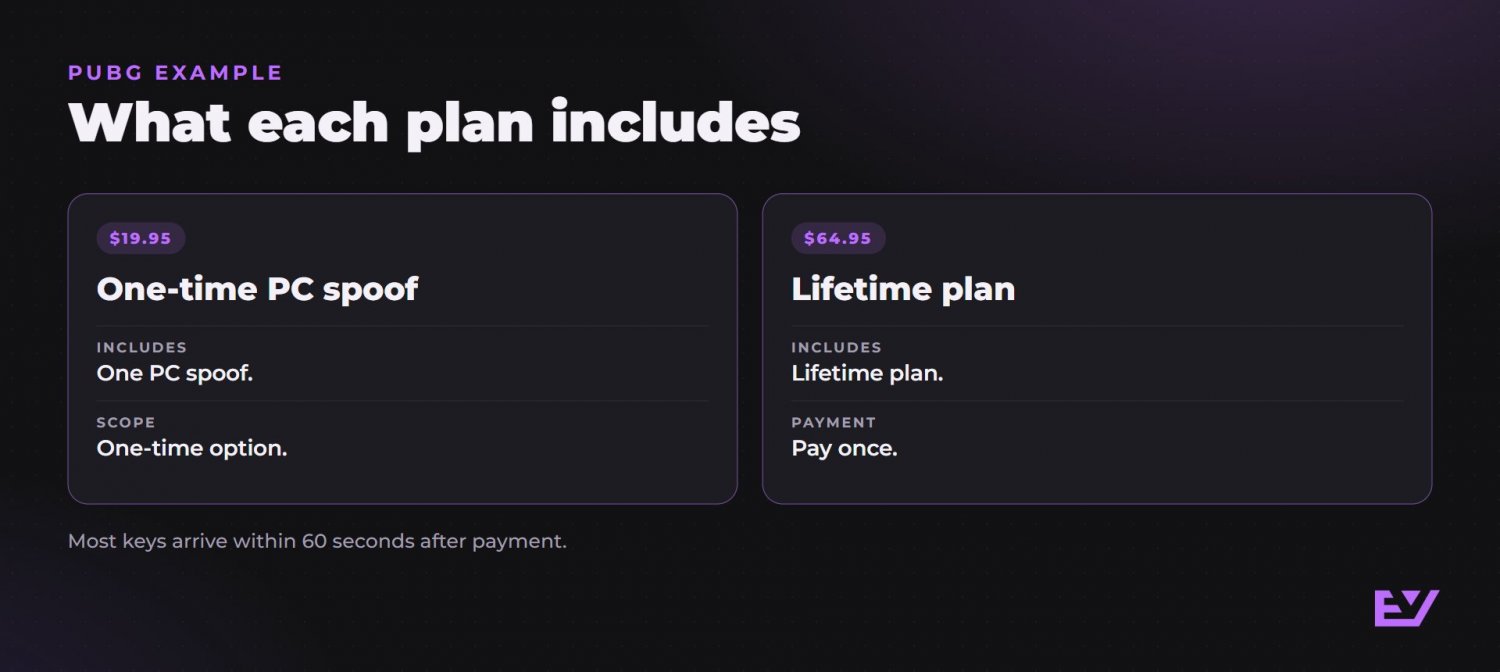
One PC spoof costs $19.95, while the lifetime plan costs $64.95 as a single payment on the PUBG example page.
For changing the identifiers read from your existing PC, with most keys delivered within 60 seconds after payment, the Evicted HWID spoofer for PUBG offers both plans. The $19.95 option includes one PC spoof. The $64.95 option is labeled Lifetime, with the payment described as pay once.
The PUBG product page lists its status as Undetected. There is a spoofer page for each game: the Rust HWID spoofer, Valorant HWID spoofer, Fortnite HWID spoofer, Apex Legends HWID spoofer, Escape from Tarkov HWID spoofer, DayZ HWID spoofer, Rainbow Six Siege HWID spoofer and Dead by Daylight HWID spoofer. Check the status listed on the page for your game.
FAQ
How quickly does the key arrive?
Most keys arrive within 60 seconds after payment. This describes key delivery, rather than setup time.
What does the seven-day guarantee cover?
If the product does not work or the account is banned within the first seven days, you get a replacement key or a full refund after a quick check.
Are there bonuses for buyers?
Buyers receive bonuses on their next purchases.
Are there separate spoofer pages for different games?
Yes. Separate game-specific spoofer pages are available, so check the relevant listing for its plans, price and listed status.
If you want one PC spoof, start with the $19.95 plan for the Evicted HWID spoofer for PUBG, with most keys delivered within 60 seconds after payment. Open the product page, review the terms and select the one-time option.
